Close your eyes and picture the life you want. Hold the image. Feel it.
You have heard that advice a hundred times. And if you have ever tried it, you may have noticed something awkward. The daydream feels lovely for a few minutes, then real life carries on exactly as before. Nothing changes. The vision board gathers dust.
So here is the honest version. Visualisation on its own does not get you the goal. The psychologist Gabriele Oettingen has spent decades showing that simply fantasising about success can actually drain your motivation, because your brain gets a small hit of the reward without you doing anything to earn it. You imagine the finish line and feel briefly satisfied, so the urge to run quietly fades.
That does not mean visualisation is useless. It means most people use it the wrong way. Done well, picturing things in your mind is one of the most practical tools you have. The difference is what you choose to picture.
Visualise the process, not just the prize
The single biggest fix is this. Stop only imagining the outcome. Start imagining the steps.
Outcome visualisation is you on the stage holding the award. Process visualisation is you at your desk at seven in the morning, tired, doing the work anyway. The second one is far less glamorous, and far more powerful. Studies on students found that picturing the process of studying led to better planning and lower stress than picturing the top grade. The mind rehearses the doing, so the doing gets easier.
When you visualise the process, you are quietly programming your brain for the moments that actually decide whether you succeed. The boring Tuesday. The setback. The choice to start before you feel ready.
 Picture the early start and the tired legs, not just the finish line. The climb is the part you train for.
Four visualisation techniques that pull you toward action
These are simple. None of them need a special room or an hour of silence. They need a few honest minutes and a willingness to picture the unglamorous parts.
Mental rehearsal
Pick one specific situation coming up this week. A difficult conversation, a workout, a piece of work you keep avoiding. Run it in your mind like a film, in detail. See yourself starting. See yourself handling the moment it gets hard. Athletes have used this for decades, and it works because your brain fires many of the same pathways whether you do a thing or vividly imagine doing it. You arrive already familiar with the moment.
The “obstacle” snapshot
This is where most visualisation falls short. After you picture what you want, deliberately picture what is likely to get in the way. Then picture exactly what you will do when it does. Tired after work, so your kit is already by the door. Tempted to scroll, so your phone is in another room. Psychologists call this mental contrasting: you hold the wish and the obstacle together, then attach a plan. It turns a daydream into a strategy.
The five senses scene
Spend two minutes in a future moment that matters to you, and make it real with detail. What can you see, hear and feel. The texture of the desk. The sound of the room. The weight of actually having shown up for yourself. Rich sensory detail makes the image stick, and a sticky image is one your brain treats as a memory of something possible rather than a vague hope.
 A sixty second preview of the day primes your attention, so the hard moment feels rehearsed instead of ambushing you.
The morning preview
Before the day starts, take sixty seconds to picture yourself moving through it well. Not perfectly. Well. See yourself handling the tricky bit on your to do list with a clear head. This primes your attention, so when the moment arrives it feels rehearsed instead of ambushing you.
Imagine the climb, not just the view from the top. The climb is the part you actually have to do.
Make it a quiet daily habit
You do not need a long ritual. You need consistency. Tie a short visualisation to something you already do, the same way you would with any habit. Sixty seconds while the coffee brews. A two minute mental rehearsal on the commute. A quick obstacle snapshot before a meeting you are dreading.
My own slot is the last few minutes before sleep. I like the idea of carrying those thoughts into the night and seeding my dreams with them, and whether or not that stands up scientifically, it has become the point in the day when I reliably do it. The part that genuinely earns its keep is acting as if. Not simply picturing having the thing, but asking how that version of me moves through an ordinary day. What are they doing? What have they already dealt with by mid morning? How do they carry themselves when it gets difficult? Answer that honestly and you have stopped daydreaming about the prize. You are rehearsing the person.
Keep it specific and keep it honest. A vague picture of “being successful” does almost nothing. A clear picture of you sitting down to do the next real task, and following it by actually sitting down, does a great deal.
Then close the loop
Here is the rule that ties all of this together. Every visualisation should end with a question. What is the one small thing I can do today that matches what I just pictured.
That question is the hinge between imagining and doing. Picture the calm conversation, then send the message that starts it. Picture the finished project, then open the file and write one paragraph. The image warms up your brain. The action is what changes your life. That blend of vision and movement is the whole idea behind our Manifestation & Taking Action writing.
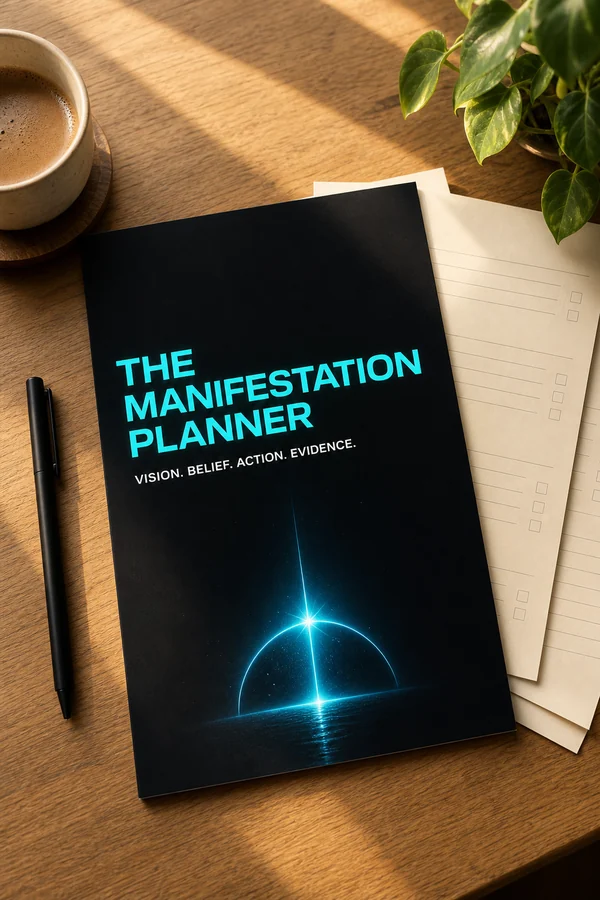
If you want somewhere to write the answer down, our free printable manifestation planner gives you a page for the vision and a page for the three actions that follow it, with a day and a time attached to each.
Visualisation is not magic, and it is not a shortcut. Used honestly, it is a rehearsal space. A place to practise being the version of you who follows through, before the real moment arrives. Spend a few minutes there each morning, then go and do the thing you saw.
That is where the picture in your head finally meets the life in front of you.
Give your mind something to repeat
Pair your morning visualisation with a short, believable affirmation built around your current focus.
Try the affirmations generator