You can be doing everything right in one part of your life and quietly falling apart in another. Smashing it at work while you have not seen a friend in weeks. Eating well and sleeping badly. Looking after everyone else and forgetting you exist.
The trouble is that this kind of imbalance is hard to see from the inside. You just feel vaguely depleted and cannot quite say why. That is exactly the gap the self care wheel fills. It takes a fuzzy feeling and turns it into something you can actually look at.
Here is what the wheel is, why it works, and how to build one that fits your life.
What is the self care wheel
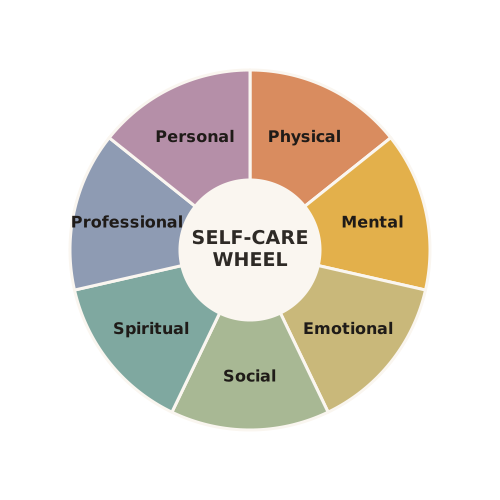
The self care wheel is a simple picture. A circle split into segments, each one a different area of your life. Physical, emotional, social, and so on. You look at each segment and ask one honest question. How well am I really caring for this part of me?
Some areas will be full. Others will be running close to empty. Seeing them side by side is the whole point. You stop treating self care as one vague thing you are either doing or not, and start seeing it as several areas that each need a bit of attention.
It is the difference between knowing you feel off and knowing your social and spiritual spokes have been empty for a month.
Why the wheel works when good intentions do not
Most of us already know we should look after ourselves. The problem is never the intention. It is that self care quietly shrinks down to whatever is easiest, and the rest gets ignored.
A wheel stops that happening. It makes the neglected areas visible, so they cannot hide. It also reframes self care as maintenance rather than reward, something you do because a life runs better when every part of it gets a little care, not something you earn after a hard week.
And because it is visual, it is fast. One glance tells you where to put your energy next.

The 7 areas of the self care wheel
Different versions of the wheel use slightly different segments, and you can adapt them to your life. Universities run the same idea as an eight dimension wellness wheel, for exactly the reason above: balance across the areas matters more than excelling in one. Here is a grounded set of seven to start from.
Physical
The foundation everything else sits on. Movement, food that fuels you, water, and above all sleep. If this spoke is empty, the others get much harder to fill. If your rest is the weak link, our guide to better sleep when insomnia hits is a good place to start.
Mental
Caring for your mind as something to keep sharp and curious. Reading, learning, journaling, and practices that quiet the noise. A few minutes of meditation belongs here, and the benefits of meditation reach into almost every other spoke too.
Emotional
Letting yourself feel things rather than managing them away. Naming emotions, processing hard ones, and being as kind to yourself as you would be to a friend. A simple self love journal is one of the easiest ways to tend this area.
Social
The relationships that hold you up. Time with people who get you, honest conversation, and the simple act of reaching out. This is the spoke that empties fastest when life gets busy, and the one you miss most without noticing why.
That happened to me without me clocking it. There was a stretch where my projects were thriving. I was in a real flow of building and creating, seeing proper progress for the first time in ages. Somewhere in that stretch my contact with family quietly thinned out. A call I meant to make became a text. A visit I meant to plan became next week, then the week after. I noticed, and told myself that sometimes you have to sacrifice things to reach your goals. Then my parents went away and left their dog with my gran, who could not manage the walks, so I stepped in. I would walk the dog and then stay a while afterwards, a cup of tea and a proper catch up, and I loved it. I think she did too. It showed me the sacrifice had never been necessary. You can stay connected to people and still get the work done. Now I visit her more often, and I phone family just to check in, even if it is only ten minutes.
Spiritual
Whatever gives your life meaning, with or without religion. Time in nature, quiet reflection, gratitude, a sense of being part of something larger. This area is about purpose, not belief.
Professional
How you spend your working hours, and whether they drain you or build you. Healthy boundaries, work that feels worthwhile, and growth that does not cost you everything else. Money and the security around it sits close to this spoke too.
Personal
The part of you that is not defined by any role. Hobbies, play, creativity, and the goals that are yours alone. Easy to drop, and one of the first things to go when life fills up.

How to build your own self care wheel
You do not need anything fancy. A piece of paper and a pen will do.
Draw the wheel. A circle split into your chosen segments. Seven is a good start, but use whatever areas fit your life.
Rate each spoke. Score every area out of ten for how well cared for it feels right now. Be honest rather than aspirational. This is just for you.
Look at the shape. A balanced wheel is round. Yours probably is not, and that is the useful part. The flat spots show you exactly where your attention is needed.
Pick one low spoke. Not all of them. One. Choose a single small action that would nudge it up a point this week. Small and real beats big and abandoned.
Come back to it. Redraw the wheel every month or so. It changes as your life does, and watching it round out over time is quietly motivating.
Keeping it going without it becoming a chore
The wheel only helps if you actually use it, and the way to do that is to keep it light. Remember the four C’s. Consistency over intensity. Commitment on the flat days. Compassion, so it never becomes another way to fall short. And choice, so you fill each spoke with what genuinely restores you, not what you think you should be doing.
Attach your check in to something you already do, like the first weekend of the month. Keep the actions tiny. And treat a low spoke as information, not failure. The wheel is not a report card. It is a map.
A more balanced life, one spoke at a time
You will never keep every area of your life perfectly full at once, and the wheel does not ask you to. What it gives you is awareness. A clear, honest picture of where you are thriving and where you have been running on empty, so you can care for yourself on purpose instead of by accident.
Start with one wheel today. Rate the spokes, find the flat spot, and take one small action towards it this week. That is how a balanced life gets built. Not in one grand gesture, but one spoke at a time. For more in this vein, the Self Compassion & Inner Work collection has plenty to explore.
When you want a gentle starting point, our free 7 Day Mindset Reset gives you one small shift a day to quiet your inner critic and care for yourself with a bit more kindness. It takes about three minutes to read.